
If you’re struggling with opioid dependence, there are two things you should keep in mind: it is not your fault, and it is never too late to seek help for it. The right opioid addiction treatment can help you successfully recover from opioid dependence, regardless of how long you’ve been fighting this battle.
However, while many treatment options are available, not all of them are equally safe or effective.
This article will explore different opioid addiction treatments and provide more information on opioid dependence to help you make the right decision and start your journey to recovery.
What are Opioids?

Opioids are a broad class of drugs commonly prescribed to relieve pain that doesn’t respond to or cannot be treated with non-opioid pain medications. Sometimes, opioids are also used to treat other conditions, such as diarrhea, coughing, and some addictions.
Depending on their origin, opioids can be:
- Natural. Also known as opiates, these are alkaloids found in the opium poppy plant. Some examples of opioids that occur naturally include thebaine and morphine.
- Semi-synthetic. This category includes opioids such as oxycodone that are created by chemically processing opiates in labs.
- Synthetic. These are designed to imitate natural opioids without actually containing them. Fentanyl and tramadol, for example, are fully human-made.
Although opioids can effectively ease chronic pain, such as that experienced by cancer patients, these drugs can be habit-forming and thus aren’t recommended for long-term pain treatment.
Due to their potency and high potential for abuse and addiction, opioids can only be obtained by prescription and should always be taken as recommended by a doctor.
Effects of Opioid Use
The primary reason for opioid use is pain relief. Opioids mimic endorphins, chemicals that are also known as natural pain relievers. Like endorphins, they attach to opioid receptors—proteins in the central nervous system (CNS)—and block pain signals.
Not only do opioids alleviate pain by preventing the brain from receiving pain signals, but they also activate dopamine release. This induces intense feelings of happiness (euphoria) and a sense of deep relaxation, a short-term effect of opioids that also makes them addictive.
Besides pain relief, euphoria, and sedation, opioids can cause various side effects, such as:
- Nausea
- Vomiting
- Constipation
- Lightheadedness
- Slowed breathing
Opioid Addiction Treatment Options
The most popular opioid addiction treatment options are:
- Medication-assisted treatment (MAT). MAT is an opioid addiction treatment that combines opioid replacement drugs with therapeutic techniques such as behavioral therapy.
- Accelerated Neuro-Regulation (ANR). Accelerated Neuro-Regulation is an innovative opioid addiction treatment that addresses the root cause of opioid addiction by bringing the endorphin-receptor system back into balance.
- Rapid detox/ultra-rapid opioid detox (UROD). Also known as anesthesia-assisted opioid detox, rapid detox is an opioid dependence treatment designed to speed up the opioid withdrawal process with the use of opioid antagonist drugs. It is performed under sedation.
Medication Used for Opioid Addiction Treatment
Some drugs commonly used in opioid addiction treatment include:
- Buprenorphine. Buprenorphine is a partial opioid agonist that alleviates withdrawal symptoms without inducing intense euphoria. However, since it belongs to the class of opioids, it still has a potential for abuse and addiction.
- Clonidine. Clonidine is a blood pressure medication that is also used to alleviate opioid withdrawal symptoms.
- Lofexidine. Lofexidine is another medication originally designed to treat high blood pressure but is now more commonly used to ease opioid withdrawals.
- Methadone. Methadone is a long-acting opioid used to replace short-acting opioids and relieve cravings.
- Naloxone. This drug blocks the effects of opioids and reverses opioid overdoses. It is often used in rapid detox to induce withdrawals and as a combined medication with buprenorphine (Suboxone®) in MAT.
US Opioid Epidemic
The opioid epidemic refers to the alarming growth of opioid abuse and overdose cases in the United States.
It started in the 1990s when doctors began prescribing opioids more and more for pain treatment, mainly due to pharmaceutical companies promoting these drugs as safe and effective.
Today, the opioid crisis is considered a public health emergency.
Here’s why:
- Each year, almost 4% of Americans misuse opioids, and around 136 people lose their lives to opioid addiction daily.
- Between January 2015 and January 2023, the number of opioid overdose deaths increased by more than 2.5 times, from just below 29,000 to over 81,000.
- Nearly 80% of heroin users misused prescription painkillers before using heroin.
What is Opioid Use Disorder (OUD)?
Opioid use disorder (OUD), of which opioid addiction is a subset, is a condition characterized by problematic opioid use. In other words, people suffering from OUD continue to take opioids despite their negative impact on their personal and professional lives.
Essentially, an OUD develops due to the chemical changes in the brain that result from prolonged opioid use. Opioids inhibit the body’s natural production of endorphins while stimulating the production of opioid receptors.
Since this chemical imbalance is the underlying cause of opioid addiction, anyone who takes opioids risks developing an OUD, making these drugs very dangerous.
To make matters worse, many people taking prescription opioids for pain relief abuse them or switch to illicit drugs if they can no longer obtain their medications legally. This can expose people to the risk of contracting diseases such as HIV/AIDS and hepatitis B or C, as well as increase the risk of suffering a potentially fatal opioid overdose.
Signs and Symptoms of Opioid Addiction
Struggling to control opioid use is a tell-tale sign of opioid addiction. Most people addicted to opioids have trouble quitting or cutting back on opioids due to uncomfortable and often painful opioid withdrawal symptoms.
While opioid addiction can look different for everyone, it almost always manifests in a combination of physical, behavioral, cognitive, and psychosocial signs and symptoms.
Most often, people addicted to opioids experience the following physical symptoms:
- Fatigue
- Digestive issues
- Breathing problems
- Opioid withdrawal symptoms
- Abdominal cramping, headaches, and other body aches
Some behavioral signs of opioid addiction include:
- Isolating from friends and family
- Hiding and/or denying opioid use
- Neglecting personal and professional responsibilities
- Showing less or no interest in previously enjoyed activities
- Lying, stealing, fabricating prescriptions, or doctor-shopping to obtain opioids

The most common cognitive signs and symptoms of opioid addiction are:
- Confusion
- Poor memory
- Difficulty focusing
- Low impulse control
- Impaired decision-making
Lastly, people addicted to opioids may display these psychosocial signs and symptoms:
- Anxiety
- Irritability
- Depression
- Mood swings
- Suicidal ideation
- Deteriorating mental health
- Failure to fulfill familial and professional obligations
Risks and Dangers of Opioid Dependency
Many people use the terms “opioid addiction” and “opioid dependence” interchangeably, but there is a difference between them.
Unlike opioid addiction, opioid dependence is physical. It is characterized by an increased tolerance to opioids as well as opioid withdrawal symptoms.
Simply put, opioid use alters the brain and makes you desensitized to these drugs. As the number of opioid receptors increases, your body develops a tolerance to opioids and needs increasingly larger amounts of them to feel their effects. This indicates opioid dependence, meaning your body needs these drugs to maintain normal functioning.
If you don’t take opioids after becoming dependent on them, you’ll experience opioid withdrawal symptoms such as cravings, sweating, vomiting, and muscle pain. These symptoms can be distressing, hard to bear, and potentially life-threatening.
To minimize the risk of relapse and quit opioids safely, never stop taking these drugs “cold turkey” or without medical supervision. If you suspect that you or someone you love might be dependent on opioids, it’s crucial to seek professional opioid dependence treatment.
If left untreated, opioid dependence can lead to:
- Opioid addiction
- Health, social, and financial problems
- Opioid overdose
- Death
ANR: The Most Superior Opioid Addiction Treatment
Accelerated Neuro-Regulation (ANR) is a revolutionary opioid addiction treatment that has helped more than 24,000 people around the world break free from opioid dependence.

ANR is the only opioid use disorder treatment that addresses the underlying causes of addiction. By rebalancing the endorphin-receptor system, ANR restores the brain to its pre-addiction state. As such, it can help you forget the fear of relapse, cravings, and other uncomfortable withdrawal symptoms!
Not only does the ANR have a very high success rate due to tackling opioid addiction at its core, but it is also very fast and safe. The procedure is performed under sedation in 4–6 hours, and the average hospital stay for ANR is just 36 hours.
Moreover, each ANR treatment is customized for every patient individually. Because of this, you can receive this opioid addiction treatment safely and successfully, even if you have complex health issues.
ANR is carried out in an ICU setting at an accredited hospital by highly trained medical professionals. Whether you’re undergoing this treatment in the United States, Brazil, Israel, or Switzerland, you can rest assured that you’ll receive the highest standard of care.
If you want to recover from opioid addiction, contact us today to schedule a free consultation!
ANR and Rapid Detox: What’s the Difference?
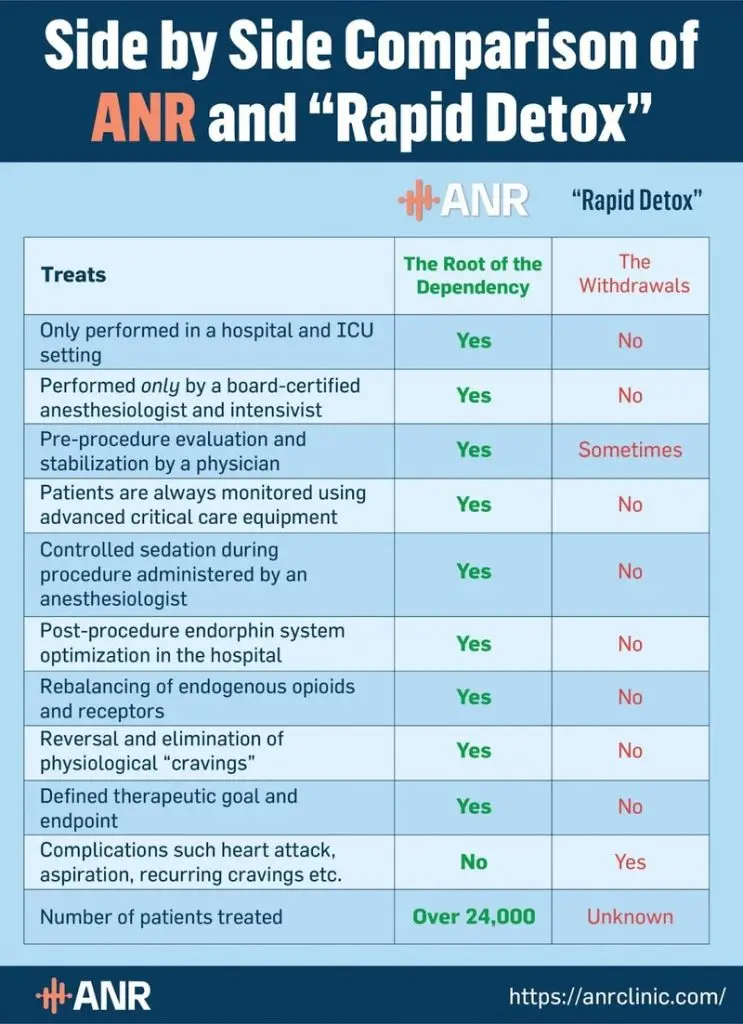
The key difference between ANR and rapid detox is that ANR addresses the neurobiological causes of opioid addiction rather than merely treating withdrawal symptoms.
Unlike rapid detox, ANR reverses the chemical changes resulting in the brain from opioid use, making it a highly effective opioid addiction treatment. Rapid detox, meanwhile, quickly flushes out opioids from the system, but it doesn’t actually cure opioid addiction.
Besides that, other differences between ANR and rapid detox include the following:
- Personalized approach. Rapid detox is a one-size-fits-all opioid abuse treatment. Meanwhile, ANR has a personalized approach to treating opioid addiction and takes the patient’s medical history, needs, opioid use, and other individual factors into consideration.
- Cost-effectiveness. ANR costs $20,500, which includes a personalized treatment plan, hospital stay, and more. Even though some rapid detox centers may offer treatments at a lower price, rapid detox doesn’t eliminate withdrawal symptoms. As such, it often leads to relapse. This isn’t the case with ANR, which makes it a much better investment.
- Safety. Unlike rapid detox, ANR is always performed by highly experienced healthcare professionals—including anesthesiologists and critical care specialists—in an ICU setting at a hospital, ensuring the highest quality and safety standards.
Key Takeaways
The bottom line is that if you’re suffering from opioid dependence or addiction, you should never quit these drugs on your own. Not only is it much harder, but it is also very dangerous. At worst, it could lead to relapse, overdose, and even death.
If you’re looking for a way to overcome an addiction to opioids quickly, safely, and effectively, your best option, by far, is ANR.
While other treatments treat withdrawal symptoms, ANR goes a major step further. It treats the addiction itself by targeting and healing opioid-induced brain changes—the fundamental cause of this issue. In turn, it helps people achieve long-term recovery from opioid addiction.
Related Articles
Painkiller Overdose: Signs, Symptoms & Prevention