
Percocet overdose is a life-threatening emergency that occurs when people take an excessive amount of this drug. It is characterized by pinpoint pupils, cold and clammy skin, and shallow breathing, among other symptoms.
Given that opioid overdoses claim the lives of tens of thousands of Americans each year, learning to recognize a Percocet overdose is of vital importance for everyone, not only those who take this drug.
This article will cover the key information you should know about Percocet overdoses, including their signs and symptoms, risk factors, and prevention tips.
What Is Percocet?

Percocet is an opioid painkiller prescribed for moderate-to-severe pain that cannot be treated with weaker pain relievers. It is classified as a Schedule II controlled substance due to the high potential for abuse, dependence, and addiction.
Percocet has two active ingredients:
- Oxycodone, a semi-synthetic opioid that became the catalyst behind the first wave of the U.S. opioid epidemic
- Acetaminophen, an over-the-counter medicine used to reduce fever and relieve mild-to-moderate pain
Acetaminophen/oxycodone is also sold as a generic drug or a brand-name medication under other brand names, such as Roxicet® and Endocet®. It comes as a tablet containing 325 mg of acetaminophen and 2.5 mg, 5 mg, 7.5 mg, or 10 mg of oxycodone. The generic version is also available as an oral liquid.
Extended use of Percocet significantly increases the risk of opioid dependence and addiction. Since chronic pain and opioid dependency often co-occur due to prolonged medication use, this drug is not recommended for chronic pain management.
Percocet Usage in the US
Here are some recent statistics on Percocet that will give you more insight into the extent of its use and misuse and the Percocet overdose rates in the United States:
- In 2023, Percocet and other oxycodone products were the most commonly misused prescription pain relievers after hydrocodone. 31.3% of Americans (2.6 million people) aged 12 and older who misused prescription painkillers abused these opioids.
- Close to 95,000 Americans lost their lives to an opioid overdose in 2022. Almost 12,000 of these deaths were attributed to natural and semi-synthetic opioids, such as Percocet.
- With over 6.5 million prescriptions issued to nearly 2.3 million Americans, acetaminophen/oxycodone was the 98th most frequently prescribed drug in the United States in 2022.
Can You Overdose on Percocet?
You can overdose on Percocet if you take more of it than your body can safely process. The dosage leading to a Percocet overdose varies individually, as it largely depends on your opioid tolerance. The lower your tolerance to opioids is, the lower the amount of Percocet your body can safely handle.
Percocet misuse considerably increases the risk of an opioid overdose. Some examples of it include:
- Taking it for non-medical purposes
- Snorting or injecting crushed tablets
- Using it for a longer than prescribed
- Mixing Percocet with alcohol or other drugs
- Taking it in larger doses or more frequently than instructed
If not treated promptly, a Percocet overdose can be fatal. Even those who survive are often left with lifelong consequences, such as organ damage, which is why you should never take more medication than prescribed or abuse it in other ways.
Percocet Overdose Signs and Symptoms
The main signs and symptoms of Percocet overdose are:
- Nausea
- Vomiting
- Confusion
- Limp muscles
- Pinpoint pupils
- Cold, clammy skin
- Unresponsiveness
- Severe drowsiness
- Low blood pressure
- Slowed, shallow breathing
- Choking or gurgling sounds
- Discolored lips and fingertips
Differentiating between a Percocet overdose and side effects can be difficult at times. It’s not uncommon for overdose symptoms to resemble the adverse effects this medication can cause, such as vomiting, drowsiness, and difficulty breathing.
However, when it comes to a life-threatening emergency like a Percocet overdose, every minute is critical for survival. Therefore, if you see someone exhibiting the above-mentioned signs, it’s best to assume it’s an overdose and call 911 immediately.
Risk Factors Leading to Percocet Overdose

The main risk factors leading to a Percocet overdose include polydrug use, opioid abuse, and low tolerance to opioids.
Let’s dissect each of these factors:
- Polysubstance use. Mixing Percocet with other drugs considerably increases the overdose risk. To prevent dangerous drug interactions, never take this medication with other substances, such as prescription or illicit drugs, herbal supplements, etc., without your doctor’s approval.
- Low tolerance. Opioid-naïve individuals can overdose on significantly lower doses of Percocet than those with a high tolerance to opioids. Therefore, you should never take medication that has been prescribed for someone else; what may be a therapeutic amount for someone could be a deadly dose for you.
- Opioid abuse. Abusing Percocet by taking it in any way other than prescribed tremendously increases the risk of a potentially fatal overdose. Follow your doctor’s instructions carefully when taking this drug. If you have any concerns (e.g., your current dose doesn’t provide sufficient pain relief), consult your doctor.
It’s important to note that abstaining from Percocet can reduce your tolerance to it so much that even your usual dose may cause a Percocet overdose if you relapse. For this reason, it is crucial to seek comprehensive opioid dependence treatment instead of opting for seemingly quick solutions like opioid detox that put you at an increased risk of relapse.
Opioid addiction treatments are only effective if they address the root of opioid dependence. Unfortunately, most opioid recovery programs fail to acknowledge the neurobiological causes of opioid dependence, let alone address them.
On this note, let’s learn more about Percocet dependence and addiction.
Percocet Addiction vs. Percocet Dependence
Percocet addiction and Percocet dependence are distinct conditions, even though they often co-occur. Although anyone taking Percocet, including those who carefully follow their doctor’s instructions, can become dependent, not everyone who develops dependence is addicted to Percocet.
Prolonged Percocet use gradually alters the brain, leading to a decrease in endorphin production and an increase in opioid receptor production, which causes tolerance. Once you become dependent, your original dose will no longer be as effective as it initially was. If this happens, talk to your doctor. Taking more Percocet than prescribed is extremely dangerous.
Plus, those dependent on opioids struggle with distressing opioid withdrawal symptoms upon Percocet discontinuation, prompting them to continue using opioids. Therefore, Percocet dependence refers to a physical reliance on this drug; opioid-dependent individuals cannot function normally without it.
Percocet addiction, on the other hand, is largely psychological. It usually develops from untreated opioid dependence, which is why getting professional help for it is vitally important.
Put simply, Percocet addiction affects your ability to control your opioid use. Tragically, people addicted to this drug can’t quit it, even when it damages or even destroys their relationships, careers, and overall well-being. Luckily, both opioid addiction and dependence can be treated.
Percocet Withdrawal Symptoms
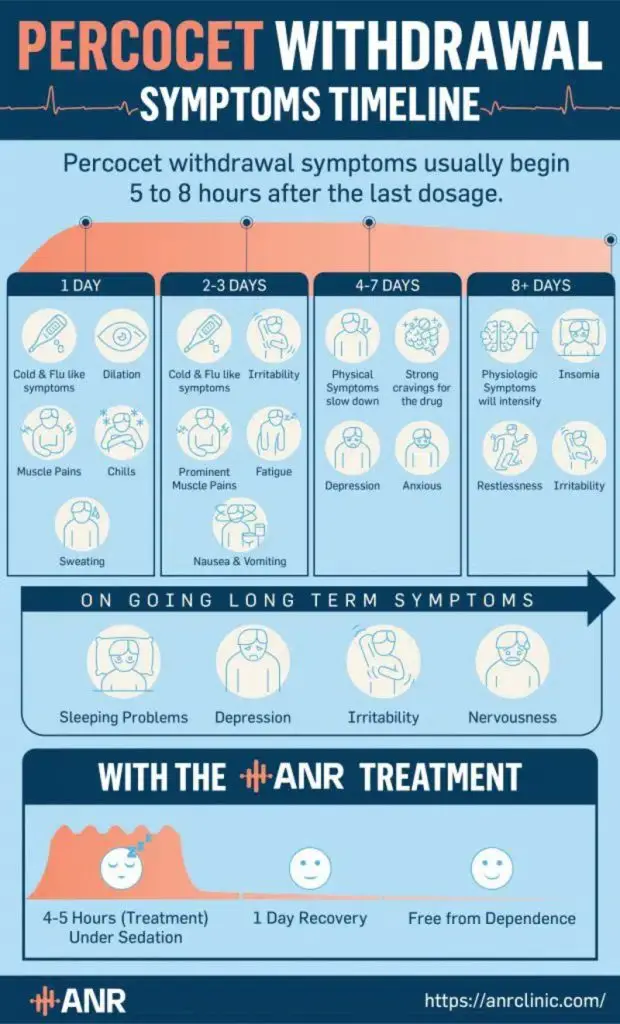
Percocet withdrawal symptoms are the uncomfortable physical and psychological effects people dependent on this drug experience upon discontinuing it or reducing the dosage.
Common withdrawal symptoms from Percocet include:
- Chills
- Anxiety
- Fatigue
- Nausea
- Diarrhea
- Vomiting
- Irritability
- Sweating
- Headache
- Depression
- Watery eyes
- Mood swings
- Dilated pupils
- Stomach ache
- Opioid cravings
- Sleep disturbances
- High blood pressure
- Muscle and joint pain
- Flu-like symptoms, such as fever and runny nose
Since Percocet is a short-acting opioid, these withdrawal symptoms usually set in within just 5–8 hours after the last dose and last around 7–10 days. However, some people develop post-acute withdrawal syndrome (PAWS), causing them to struggle with psychological effects like cravings and depression for months and even years after quitting Percocet.
Percocet withdrawal treatment at home is not recommended under any circumstances due to the risk of severe withdrawal symptoms, complications, relapse, and subsequent overdose. If you’re looking to get off Percocet, the safest option is to seek professional help.
Preventing Percocet Overdose
The only 100% effective way to prevent a Percocet overdose is not to take this medication in the first place. For your safety, do not initiate opioid therapy before ruling out other non-opioid pain management options.
Understandably, certain conditions may leave you with no option but to take Percocet. Here’s what you can do in this case to reduce the risk of a Percocet overdose:
- Carefully follow your doctor’s instructions. Do not take Percocet in higher doses or more frequently than prescribed.
- Stay in touch with your doctor. Consult with your doctor if you have any concerns about using Percocet, experience any side effects, or have any other medical issues.
- Do not engage in polydrug use. Never take Percocet with other substances without your doctor’s approval.
- Track your opioid intake. Monitor your medication use to ensure you don’t take an extra pill by accident. If you miss a dose, simply skip it until it’s time to take the next one.
- Get professional help. Seek professional opioid dependence treatment if you believe you might be dependent on or addicted to Percocet.
ANR Treatment for Percocet Dependence

Accelerated Neuro-Regulation (ANR) is a groundbreaking opioid dependence treatment developed by Dr. Andre Waismann.
Unlike traditional treatments, ANR targets the root of the problem instead of treating its symptoms. It eradicates opioid dependence by re-regulating the endorphin-receptor system. Reversing opioid-induced neurochemical changes allows ANR to bring the brain back to a pre-dependence state, eliminating withdrawal symptoms
ANR has been scientifically proven safe and effective. The ANR team consists of highly experienced and compassionate board-certified healthcare professionals, including anesthesiologists and critical care physicians. Furthermore, the treatment is carried out in an ICU setting of fully accredited hospitals with state-of-the-art medical equipment.
Benefits of Undergoing ANR Treatment
The key benefits of undergoing ANR treatment include:
- Fast results. As a comprehensive opioid dependence treatment, ANR brings lasting results. The average hospital stay for the ANR procedure lasts just 36 hours, and patients can return home in a matter of days.
- Personalized approach. Each ANR patient receives a treatment plan tailored to their unique medical history and needs. As such, this treatment is suitable for almost everyone, including those with complex medical conditions.
- Unmatched effectiveness. As the first and only treatment that addresses the root cause of opioid dependence, ANR is highly effective. It negates the risk of relapse by eliminating cravings and other withdrawal symptoms. As of today, this innovative treatment has supported close to 25,000 people worldwide in making a lasting recovery.
Meet Amanda, our fearless patient who won the battle against opioid dependence, which started with Percocet when she was just 16, by undergoing ANR:
Ready to reclaim your life? Contact us for a free, 100% confidential consultation to learn how ANR can help you return to an opioid-free life.
Key Takeaways
Percocet overdose can only be prevented by not taking this drug, which is why opioid therapy should be your last resort. If you do have to take it, follow your doctor’s instructions precisely to reduce the overdose risk.
Now, let’s go over the key points we covered:
- Percocet is a drug containing oxycodone and acetaminophen that can effectively control moderate-to-severe pain but has a high potential for abuse, dependence, and addiction.
- The main signs and symptoms of a Percocet overdose include trouble breathing, extreme confusion, unresponsiveness, and pinpoint pupils.
- Opioid abuse, polydrug use, and low opioid tolerance considerably increase the risk of suffering a Percocet overdose.
- ANR is an ultra-modern treatment for Percocet dependence that can help you break the cycle of opioid abuse and dependence through endorphin-system modulation.
Related Articles
Tramadol vs. Percocet: Differences, Risks and Treatment