
Hydrocodone stays in your system between 20 and 45 hours. Nonetheless, the answer to “How long does hydrocodone stay in your system?” varies from one person to another, as it depends on various individual factors.
Understanding how your body processes and eliminates hydrocodone can help you not only prepare for a drug screening but also reduce the risk of opioid overdose.
Keep reading to find out the key factors that determine how long hydrocodone stays in your system and learn more about this effective yet highly addictive painkiller.
What Is Hydrocodone?
Hydrocodone is a potent prescription opioid used to manage moderate-to-severe pain resistant to non-opioid pain relievers. As a semi-synthetic opioid, it is produced by synthesizing thebaine or codeine, natural alkaloids found in the opium poppy.
Hydrocodone is sold as an extended-release drug, with Hysingla® ER and Zohydro® ER being some of the most common brand names for it. However, it is more commonly combined with acetaminophen and marketed under the following brand names:
- Vicodin®
- Lortab®
- Norco®
While single-entity hydrocodone is only available in tablets and capsules, combination hydrocodone products are also available as oral solutions.
Moreover, hydrocodone/acetaminophen is the most commonly prescribed opioid medication in the United States. Nearly 26.6 million prescriptions of this combination hydrocodone product were issued to more than 8.6 million Americans in 2021.
Even though hydrocodone can effectively soothe pain, it exposes you to the risk of opioid abuse, dependence, addiction, and overdose. Due to this, all hydrocodone products are treated as Schedule II controlled substances and can only be legally obtained by prescription.
Nonetheless, hydrocodone is a popular street drug, commonly known by Fluff, Hydro, and Viko street names. It is also the most frequently abused prescription painkiller in the United States. In 2022, an overwhelming 45.1% of prescription pain reliever misusers above the age of 12 misused hydrocodone products specifically.
How Does Hydrocodone Affect Your Body?
Hydrocodone affects the body by mimicking the effects of natural endorphins and binding to the opioid receptors in the central nervous system (CNS). This way, it prevents pain signals from reaching the brain.
It starts to relieve pain within 30 minutes following ingestion, with effects lasting for 4–24 hours, depending on the drug’s formulation, dosage, and so forth.
Moreover, hydrocodone induces feelings of euphoria and deep relaxation by stimulating dopamine release, which increases its potential for abuse. It can also cause various side effects, some of which, like trouble breathing, may require immediate medical attention.
The most common hydrocodone side effects are:
- Fatigue
- Nausea
- Vomiting
- Dry mouth
- Constipation
- Stomach ache
- Trouble urinating
- Lightheadedness
- Difficulty breathing
Importantly, hydrocodone products containing acetaminophen carry a higher risk of liver damage and may not be suitable for those with liver disease.
Hydrocodone Half-Life
Hydrocodone’s half-life—or the time it takes your body to clear half a dose of it—is roughly four hours. However, extended-release hydrocodone has a half-life of 7–9 hours.
Though this means that it will take your body anywhere between 4 and 9 hours to reduce the drug’s concentration by half, it usually takes around five half-lives to completely eliminate opioids from the system.
With that in mind, let’s move on to the question, “How long does hydrocodone stay in your system?” and discuss how long different drug tests can detect it.
How Long Does Hydrocodone Stay in Your System?
Immediate-release hydrocodone stays in your system for about 20 hours, whereas extended-release hydrocodone remains in the body for roughly 45 hours.
That said, “How long does hydrocodone stay in your system?” and “How long does hydrocodone remain detectable on drug tests?” are two different questions; some drug tests may detect it days and even months after the last dose.
Let’s find out how long hydrocodone stays in blood, hair, saliva, and urine.
How Long Does Hydrocodone Stay in Blood?
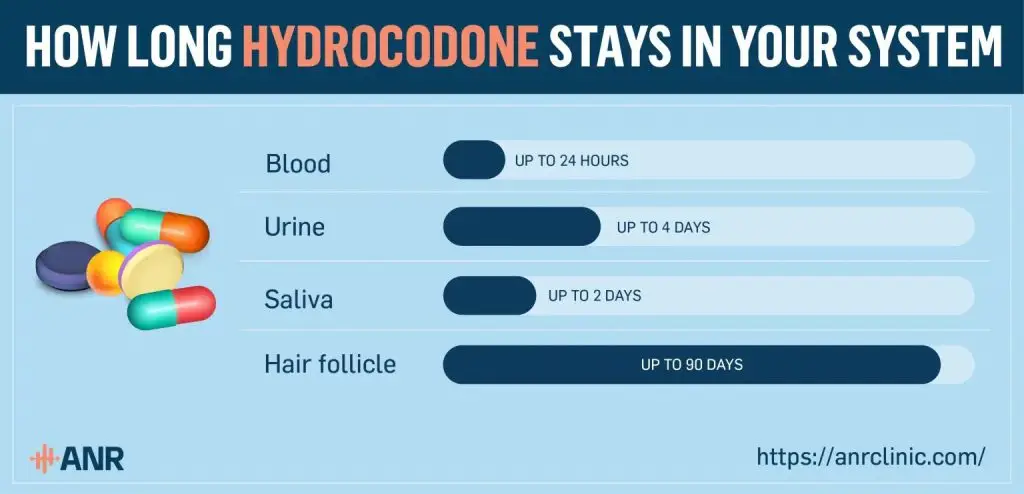
Hydrocodone stays in the blood for up to 24 hours after your last dose. Since it can be detected in blood samples for no longer than one day, blood tests can only be performed to test for recent hydrocodone use. They are also more invasive than other testing methods.
How Long Does Hydrocodone Stay in Hair?
Hydrocodone stays in hair for up to 90 days, meaning hair follicle tests may detect traces of hydrocodone for around three months after taking the last dose. Though hair follicle tests have the longest detection window, they tend to be more expensive than other tests.
How Long Does Hydrocodone Stay in Saliva?
Hydrocodone stays in saliva and remains detectable in saliva samples for up to 48 hours following consumption. Saliva tests are performed by taking an oral swab and sending it to the laboratory for hydrocodone detection.
How Long Does Hydrocodone Stay in Urine?
Hydrocodone stays in urine for up to four days after the last dose. Urine testing for hydrocodone is fairly common, as urine tests have a longer detection window than most other methods. They are also simple to administer and cost-effective.
Now that we’ve covered hydrocodone detection windows in different drug tests, it’s important to note that the answer to “How long does hydrocodone stay in your system?” depends not only on the drug’s formulation but also on several individual factors. Let’s find out what they are.
Factors That Determine How Long Hydrocodone Stays in Your System
One key factor determining how long hydrocodone stays in your system is liver health. Hydrocodone is predominantly metabolized in the liver into hydromorphone and norhydrocodone. Consequently, impaired liver function may prolong the time it takes your body to process and eliminate hydrocodone.
Other factors that determine how long hydrocodone stays in your system are:
- Age. As a general rule, younger people need less time to break down hydrocodone and flush it out of their system than older individuals, as the metabolic rate slows down with age. Younger people also tend to have fewer health issues that may affect hydrocodone metabolism and elimination.
- Metabolism. The faster your metabolism is, the quicker your body processes and clears substances, including hydrocodone. Diet, physical activity, and other factors that may boost or slow your metabolism can also affect how long hydrocodone stays in your system.
- Polydrug use. Taking hydrocodone with other substances can not only lead to dangerous drug interactions but also impair your body’s ability to process opioids. If you take any illicit drugs, prescription medications, herbal supplements, or other similar substances, inform your doctor about them to ensure they can be safely taken with hydrocodone. Never mix opioids with alcohol or other substances without your doctor’s approval.
- Extent of hydrocodone use. How long hydrocodone stays in your system also depends on how long, how often, and at what doses you’ve been taking it. Simply put, someone who has been dependent on hydrocodone for years will require more time to clear it out than those who have been taking it for several weeks at minimum doses.
Hydrocodone Addiction vs. Hydrocodone Dependence
Hydrocodone addiction and hydrocodone dependence are two distinct conditions, even though these terms are often used interchangeably.
Since repeated opioid exposure alters brain chemistry, anyone using this medication for a prolonged time can become dependent on or addicted to hydrocodone. Those who take it precisely as prescribed, unfortunately, are no exception.
Taking hydrocodone over an extended time causes the brain to produce more and more opioid receptors, leading to tolerance, which signifies physical dependence. Once you build up a tolerance, your body will require larger amounts of the drug to continue feeling its effects.
Moreover, people dependent on hydrocodone have to rely on it to function normally, as the absence of the drug triggers uncomfortable opioid withdrawal symptoms. These symptoms are often so distressing that many people continue taking hydrocodone just to prevent them, even when they no longer need it for pain management.
If left untreated, hydrocodone dependence can develop into an addiction, which is predominantly psychological. Those struggling with prescription drug addiction lose control over their impulses and can’t help but take opioids, even when this wreaks havoc on their lives.
Though devastating, hydrocodone addiction is a treatable condition. Professional opioid addiction treatment can help you overcome it safely and effectively.
Hydrocodone Withdrawal Symptoms
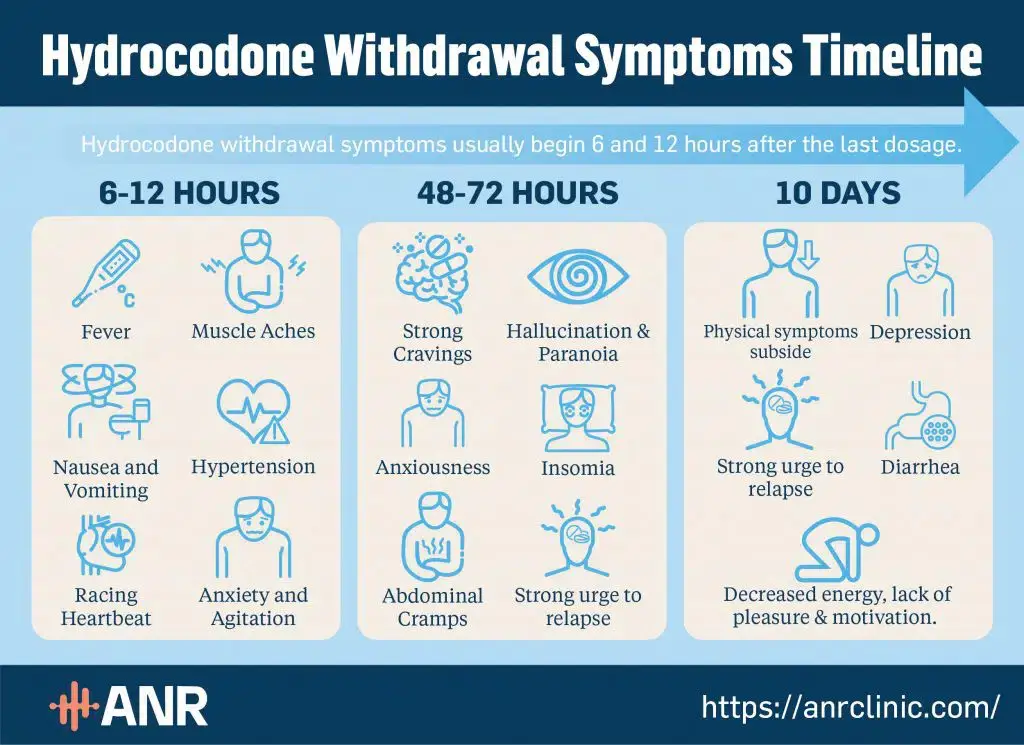
Hydrocodone withdrawal symptoms occur in opioid-dependent people once they discontinue medication. Quitting hydrocodone “cold turkey” may cause particularly severe symptoms and increase the risk of potentially life-threatening complications. Therefore, you should never quit your medication abruptly or without medical supervision.
The most common hydrocodone symptoms are:
- Anxiety
- Diarrhea
- Insomnia
- Sweating
- Shivering
- Joint pain
- Headache
- Depression
- Dilated pupils
- Goosebumps
- Muscle aches
- Nausea and vomiting
- Hydrocodone cravings
- Increased heart rate and blood pressure
- Fever, runny nose, and other flu-like symptoms
These symptoms typically set in within 6–12 hours after the last dose of short-acting hydrocodone and within 24 hours after the last dose of long-acting hydrocodone. Though they usually subside within a week or two, some people continue to suffer from intense opioid cravings, depression, and other psychological symptoms for months and even years.
Suffering from hydrocodone withdrawal symptoms increases the risk of relapse, which can lead to a life-threatening hydrocodone overdose. Getting professional opioid dependence treatment can minimize this risk and help you successfully quit hydrocodone.
ANR Opioid Dependence Treatment
Accelerated Neuro-Regulation (ANR) is an innovative opioid dependence treatment that can help you break free from hydrocodone dependence in a matter of days.
Developed by Dr. Andre Waismann, ANR has helped close to 25,000 patients worldwide make a long-lasting recovery from opioid dependence.

It’s the first and only treatment that tackles the root cause of opioid dependence instead of merely treating the symptoms. By re-regulating the endorphin-receptor system, the ANR treatment restores the brain to its pre-addiction state, eliminating cravings and other withdrawal symptoms. As a result, it negates the risk of relapse.
Most importantly, the safety of the ANR treatment is scientifically proven. Since the treatment is tailored to each patient’s medical history and needs, it can be safely performed even on those with co-occurring medical conditions, such as heart disease.
To ensure the highest standards of patient safety and care, ANR is only carried out in an ICU setting of accredited hospitals by highly experienced board-certified medical professionals. While the procedure itself takes 4–6 hours, the hospital stay for our patients lasts only 36 hours on average.
Ready to kickstart your recovery journey? Contact us for a free consultation today!
Key Takeaways
“How long does hydrocodone stay in your system?” is a quite complicated question; its answer varies individually. However, immediate-release hydrocodone stays in the system for a shorter time (around 20 hours) than extended-release hydrocodone (around 45 hours).
Lastly, let’s summarize what we covered today:
- Hydrocodone is the most commonly prescribed opioid for moderate-to-severe pain, but it carries a high potential for abuse, dependence, and addiction.
- Hydrocodone’s half-life ranges between 4 and 9 hours, which means it can take your body up to 45 hours, and sometimes even more, to clear it out.
- How long hydrocodone stays in your system depends on its formulation, metabolism, age, liver function, and the extent of your hydrocodone use.
Additional Information
Hydrocodone and Trazodone Interaction