A morphine overdose is a life-threatening emergency that occurs when people take a larger amount of this drug than their bodies can safely process. As a potent opioid, morphine can dangerously suppress the nervous system when taken at high doses. Receiving prompt medical help for a morphine overdose is vital; if not treated on time, it can have fatal consequences.
This article will cover the key information on morphine overdose you should know and explain how ANR—an ultra-modern treatment for opioid dependence—can help you put an end to morphine dependence.
What Is Morphine?

Prescribed for moderate-to-severe pain that cannot be managed with non-opioid pain relievers like aspirin, morphine is the oldest opioid analgesic. Classified as a Schedule II controlled substance, it should be taken strictly as prescribed to reduce the risk of dependence, addiction, and overdose.
As a natural opioid, morphine is an alkaloid that is extracted directly from the opium poppy plant. Besides pain management, it is also used in the production of semi-synthetic opioids.
Some common morphine derivatives include:
There are several types of morphine, including liquid solutions, injections, tablets, and capsules. Sold as a generic drug and under various brand names like MS Contin® and Kadian®, it is available in both immediate- and extended-release formulations.
Morphine effectively alleviates discomfort by attaching to opioid receptors and blocking pain signals from reaching the brain. It also stimulates dopamine release, inducing feelings of euphoria and relaxation that add to the drug’s potential for abuse and addiction.
Morphine Usage in the US
Here are some recent statistics on morphine usage and morphine overdose rates in the United States:
- More than 10% of the American population has used morphine at least once in their lifetime.
- 70% of Americans battling prescription drug addiction are addicted to prescription opioids, such as morphine.
- Nearly 6% of Americans above the age of 12 who used morphine products in 2023 abused them.
- With over 4.1 million prescriptions issued to nearly 800,000 Americans, morphine was among the most frequently prescribed opioids in 2022.
- In 2022, close to 95,000 Americans lost their lives to an opioid overdose; almost 12,000 of these deaths were caused by morphine and other natural and semi-synthetic opioids.
Can You Overdose on Morphine?
You can overdose on morphine, especially if you take it in other ways than prescribed. Without prompt treatment, a morphine overdose can be deadly.
Even if you survive, overdosing on morphine can have lifelong consequences, such as organ damage. Because of this, it’s in your best interest to carefully track your drug intake and follow your doctor’s instructions to a T, as this can reduce the risk of a morphine overdose.
Each person has a different level of opioid tolerance, meaning there’s no predetermined morphine overdose amount. The lower your tolerance, however, the less you need to reach the morphine overdose limit. One person’s normal daily dose could be lethal to someone else, which is why you should never take medications that haven’t been prescribed for you.
Some ways in which people abuse morphine, significantly increasing the risk of a potentially fatal opioid overdose, include:
- Taking it more frequently or in higher doses than prescribed
- Consuming the medication in other ways than prescribed, such as snorting crushed tablets
- Engaging in polysubstance abuse, i.e., mixing morphine with other drugs without the doctor’s permission
Next, let’s explore the signs of morphine overdose that you should never ignore.
Morphine Overdose Signs and Symptoms

The key signs and symptoms of morphine overdose include:
- Nausea
- Vomiting
- Limp body
- Weak pulse
- Severe confusion
- Unresponsiveness
- Extreme drowsiness
- Loss of consciousness
- Gurgling or choking sounds
- Discolored skin, lips, and fingertips
- Slow, shallow, or stopped breathing
Furthermore, a tell-tale sign of morphine overdose is pupil constriction, also known as miosis. Overdosing on opioids usually causes small, pinpoint pupils. The eyes may also fail to respond to light or other stimuli.
Telling apart an overdose from morphine side effects may be tricky, as some of the symptoms—namely, nausea, vomiting, and difficulty breathing—overlap.
However, the reversal of a morphine overdose is only possible with immediate medical help. Therefore, it’s best to call 911 as soon as you suspect someone may be overdosing on morphine or another opioid.
Risk Factors Leading to Morphine Overdose
The risk factors leading to morphine overdose include opioid abuse, low tolerance, and polysubstance use.
Let’s examine these factors in greater detail:
- Opioid abuse. Abusing the drug by taking it in any other way than prescribed considerably amplifies the risk of a life-threatening morphine overdose. For this reason, you should follow your doctor’s directions precisely when taking this medication. If your current dose doesn’t provide enough relief, consult your doctor. The last thing you want to do is to take more morphine than prescribed without their approval.
- Low tolerance. Opioid-naïve people face a significantly higher morphine overdose risk than those who have developed a high tolerance to opioids. This makes relapse extremely dangerous, as abstinence reduces your tolerance to drugs. If you relapse, even your typical dose may be potent enough to suppress your breathing and cause an overdose.
- Polysubstance use. Certain substances, such as benzodiazepines, seizure medications, and antidepressants, may interact with morphine, greatly increasing the risk of an overdose. Plus, recognizing and treating an overdose caused by several substances can be very challenging. Therefore, you should not mix morphine with any medications and supplements without consulting your doctor.
Additionally, morphine dependence and addiction can be regarded as risk factors for opioid overdose. This is because people dependent on or addicted to this drug are more likely to take it at higher doses or misuse it in other ways. Since prolonged opioid use enhances the risk of opioid dependence and addiction, you should limit your opioid use to a minimum.
With this in mind, let’s discuss the difference between morphine dependence and addiction.
Morphine Addiction vs. Morphine Dependence
Morphine addiction and morphine dependence are distinct conditions, though these terms are often used interchangeably. The main difference between them is that morphine dependence is physical, whereas addiction is largely psychological.
Anyone taking morphine for a prolonged time will become dependent on it, even those who take it as prescribed. This is because repeated opioid exposure causes the brain to stop producing endorphins while stimulating the production of opioid receptors, leading to a physical reliance on the drug.
Simply put, once you become dependent on morphine, you’ll need to take it to function normally. Eventually, your initial dose will become less effective due to tolerance, prompting you to take increasingly larger doses.
Furthermore, if you stop taking it, you’ll experience uncomfortable opioid withdrawal symptoms. This is precisely what keeps most people stuck in the cycle of opioid abuse.
Luckily, opioid dependence is treatable. Overcoming it is key to preventing opioid addiction, a condition characterized by a loss of control over drug use. Those addicted to morphine cannot help but take it, even when it ruins their or their loved ones’ lives.
The classic symptoms of morphine addiction include:
- Abusing opioids
- Withdrawing from loved ones
- Neglecting personal and professional obligations
- Being preoccupied with obtaining and using opioids
- Having a history of failed attempts at quitting morphine
- Trying to obtain morphine in any way, including stealing, doctor shopping, forging prescriptions, etc.
Morphine Withdrawal Symptoms
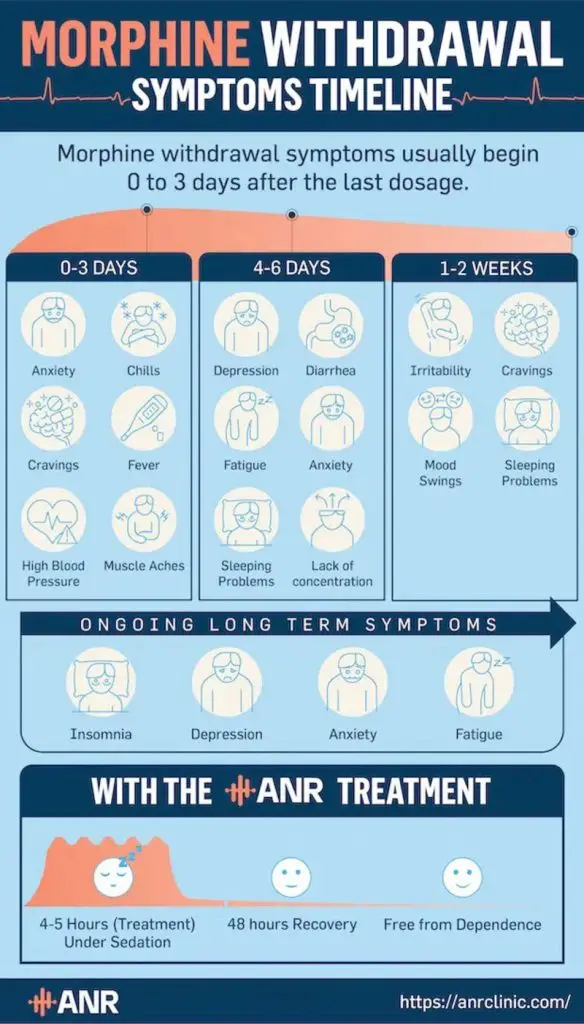
Morphine withdrawal symptoms are a set of physical and psychological symptoms that opioid-dependent people experience after morphine discontinuation.
The most common morphine withdrawal symptoms include:
- Fever
- Fatigue
- Anxiety
- Nausea
- Vomiting
- Diarrhea
- Cravings
- Irritability
- Insomnia
- Sweating
- Headache
- Runny nose
- Watery eyes
- Mood swings
- Dilated pupils
- Excessive yawning
- High blood pressure
- Difficulty concentrating
- Muscle and joint aches
The intensity and duration of morphine withdrawal varies based on the extent of opioid use, the drug’s formulation, and other factors, such as liver function. Quitting “cold turkey” can cause particularly severe mental distress and physical discomfort, increasing the risk of relapse and subsequent morphine overdose. Therefore, it is not recommended under any circumstances.
In most cases, morphine withdrawal symptoms last about two weeks, though cravings and other psychological symptoms may linger for a longer time. Furthermore, some people continue to suffer from withdrawal symptoms for months and even years after quitting morphine, which is known as post-acute withdrawal syndrome (PAWS).
It is imperative to seek professional medical help to reduce the risk of severe withdrawal symptoms, relapse, and PAWS, among other complications. A comprehensive opioid dependence treatment can help you get off morphine safely and increase the chances of a lifelong recovery.
Preventing Morphine Overdose
The only foolproof way to prevent a morphine overdose is not to take this drug. After all, a single extra pill taken by accident could have dangerous—and even fatal—consequences. You should always explore non-opioid pain management options before initiating morphine therapy.
If you have to take morphine, here’s what you can do to reduce the risk of morphine overdose:
- Take your medication exactly as prescribed and track your opioid intake.
- Check with your doctor if the drugs or supplements you’re using can be safely taken with morphine.
- Do not mix opioid medications like morphine with alcohol or other substances without your doctor’s approval.
- Work closely with your doctor and inform them about any side effects or other concerns you have.
- If you miss a dose or aren’t sure if you’ve already taken it, skip it until it’s time for your next dose.
- If you believe you might’ve become dependent on or addicted to morphine, seek professional opioid dependence treatment.
ANR Treatment for Morphine Dependence

Accelerated Neuro-Regulation (ANR) is a revolutionary opioid dependence treatment developed by Dr. Andre Waismann. By restoring normal brain function, ANR can help you recover from morphine dependence quickly, safely, and effectively.
As the only method that treats the root of opioid dependence, ANR treatment boasts an exceptionally high success rate. As of today, it has helped close to 25,000 people worldwide reclaim their lives.
This treatment achieves its therapeutic goal of neuro-equilibrium by re-regulating the endorphin-receptor system while the patient is sedated. By reversing the neurochemical imbalance caused by prolonged opioid use, ANR eliminates the risk of ongoing withdrawal symptoms and relapse, facilitating lasting recovery.
Benefits of Undergoing ANR Treatment
Besides effectiveness, some of the key benefits of undergoing ANR treatment include:
- Patient safety. The safety of ANR is proven scientifically. The procedure is performed in an ICU setting of accredited hospitals with state-of-the-art equipment by highly experienced board-certified healthcare professionals.
- Personalized care. Unlike traditional methods, ANR treatment is personalized to each patient individually. Since the treatment plan is tailored to the patient’s medical history and needs, it can be safely performed even on those with complex health conditions, such as liver disease.
- Short treatment duration. As a comprehensive treatment, ANR can help you overcome opioid dependence within a matter of days. Most of our patients are discharged after a short 36-hour hospital stay.
Getting started with ANR is as easy as scheduling a free, 100% confidential consultation with us. Contact us today to jumpstart your recovery journey!
Key Takeaways
The bottom line is that taking morphine precisely as prescribed is critical to reducing the overdose risk.
Unfortunately, many patients taking this drug end up becoming dependent, which significantly increases the risk of opioid abuse and subsequent overdose. Therefore, receiving professional help for morphine dependence is paramount.
Let’s briefly go over the key points we covered today:
- Morphine is a prescription opioid used to control moderate-to-severe pain when weaker analgesics don’t help.
- You can overdose on morphine by taking too much of it, which is why you should never misuse it by taking more than prescribed or mixing it with other substances.
- ANR is an innovative treatment that can help you conquer morphine dependence quickly and effectively by returning your brain to its pre-dependence state.