Vicodin overdose is a life-threatening emergency that occurs as a result of the excessive consumption of this opioid. Although preventable, thousands of Americans lose their lives to it each year, and many more face devastating long-term effects, such as organ damage, after surviving.
Given the extent of opioid use and abuse in the United States, learning to recognize and prevent a Vicodin overdose is of vital importance to virtually everyone—not only those taking this powerful drug.
This article will explain the key things you should know about Vicodin overdoses, from causes to prevention.
What Is Vicodin?

Vicodin is a combination drug made up of the opioid hydrocodone and acetaminophen, an over-the-counter analgesic. It is prescribed for moderate-to-severe pain that cannot be controlled with non-opioid pain relievers.
Vicodin comes as a tablet, whereas generic acetaminophen/hydrocodone is also available as an oral solution. Vicodin tablets contain 300 mg of acetaminophen and 2.5 mg, 5 mg, 7.5 mg, or 10 mg of hydrocodone. It is also sold under other brands like Lortab®, Norco®, and Lorcet®. On the streets, Vicodin is called Vike, Watson-387, Vic, or Hydro.
Vicodin was moved from Schedule III controlled substances to Schedule II in 2014 due to its high potential for opioid abuse, dependence, and addiction. Taking it as instructed is critical to reducing these risks and avoiding a potentially life-threatening Vicodin overdose.
Vicodin Usage in the US
Here are some recent Vicodin statistics that illustrate the extent of acetaminophen/hydrocodone use and Vicodin overdose rates in the United States:
- Americans consume 99% of the world’s hydrocodone supply.
- With 8% of students reporting Vicodin use, it ranks as the top prescription drug among high school seniors.
- Natural and semi-synthetic opioids like Vicodin have claimed the lives of roughly 10,000 Americans in 2023 alone.
- With over 23.5 million prescriptions issued to nearly 8 million Americans, Vicodin was the most frequently prescribed opioid medication in the United States in 2022.
- Hydrocodone products were the most commonly misused pain relievers among Americans above the age of 12 in 2023. Around 3.6 million people misused Vicodin or other hydrocodone products that year.
Can You Overdose on Vicodin?
You can overdose on Vicodin if you take a larger dose than what your body can safely process. Opioid overdoses occur as a result of an excessive amount of opioids in the system, which can dangerously suppress a person’s respiratory system. If not treated on time, a Vicodin overdose can cause brain injury, coma, and even death.
The amount leading to a Vicodin overdose varies from person to person; the lower your opioid tolerance is, the lower the dosage you need to reach the Vicodin overdose limit. For this reason, you should never take more Vicodin than prescribed.
Opioid abuse dramatically increases the risk of a Vicodin overdose. Sadly, Vicodin abuse isn’t rare; many people use this drug in other ways than prescribed to enhance its euphoric effects, even if it amplifies the risk of overdose.
Some examples of Vicodin abuse include:
- Using it for non-medical purposes
- Mixing it with alcohol or other drugs
- Consuming it in other ways than prescribed (e.g., injecting crushed tablets)
- Taking it in larger doses, more frequently, or for a longer time than prescribed
Vicodin Overdose Signs and Symptoms
The main signs and symptoms of a Vicodin overdose include:
- Nausea
- Vomiting
- Confusion
- Constricted pupils
- Unresponsiveness
- Severe drowsiness
- Low blood pressure
- Slow, shallow breathing
- Cold, pale, clammy skin
- Discolored, blue-tinted nails and lips
It may not always be easy to discern a Vicodin overdose from Vicodin side effects or a very intense “high,” as all of these can cause similar effects like drowsiness.
However, it’s always best to err on the side of caution and get medical help immediately if you notice someone displaying possible signs of a Vicodin overdose. Prompt medical intervention is the only way to prevent an overdose death and reduce the likelihood of lifelong consequences, such as brain damage or chronic respiratory problems.
Risk Factors Leading to Vicodin Overdose

The key risk factors leading to Vicodin overdose include Vicodin abuse, low opioid tolerance, and polysubstance use.
Let’s discuss these risk factors in more detail:
- Vicodin abuse. More often than not, what causes a Vicodin overdose is the abuse of this opioid. In other words, taking Vicodin in any way other than prescribed puts you at an increased risk of experiencing a Vicodin overdose. Therefore, you should never take opioids in larger amounts than prescribed; if your current dose loses its effectiveness due to tolerance, talk to your doctor.
- Polysubstance use. Polysubstance use is a form of opioid abuse, as well as one of the main risk factors for Vicodin overdose. Illicit drugs, prescription medications, and even herbal medicines can impact your body’s ability to metabolize Vicodin. Taking it with substances your doctor hasn’t approved of can significantly increase the risk of adverse effects like respiratory depression, overdose, and death.
- Low opioid tolerance. The same amount of Vicodin can affect people differently based on their opioid tolerance; opioid-naïve people can overdose on much smaller amounts than those who have been taking Vicodin for an extended time. Because of this, relapse is particularly dangerous, as abstaining from Vicodin reduces your tolerance to it. As such, even your usual dose may cause a Vicodin overdose if you relapse.
Vicodin Addiction vs. Vicodin Dependence
Although Vicodin addiction and Vicodin dependence often co-occur and anyone taking this drug risks developing both of these conditions, they aren’t the same.
Developing dependence is a matter of when, not if, for anyone who takes Vicodin for a prolonged time. Repeated opioid exposure affects the brain at a neurochemical level, causing it to cease producing endorphins and create more opioid receptors, which leads to tolerance.
Therefore, if you use Vicodin regularly, it’s only a matter of time before your dose will lose its effectiveness. Tolerance is a tell-tale sign of opioid dependence, which refers to the physical reliance on Vicodin or another opioid.
Dependence is also characterized by the presence of opioid withdrawal symptoms upon drug discontinuation. Given how uncomfortable these symptoms can be, it’s no surprise that thousands of Americans continue to take opioids just to prevent them.
Leaving Vicodin dependence untreated can—and often does—lead to addiction, also known as opioid use disorder (OUD). Unlike dependence, Vicodin addiction is largely psychological; it is characterized by a compulsive need to take opioids, even when it leads to relationship problems, legal issues, job loss, and other repercussions.
Some common signs and symptoms of Vicodin addiction include:
- Abusing Vicodin
- Hiding or lying about Vicodin use
- Feeling unable to stop taking opioids
- Becoming withdrawn from friends and family
- Being preoccupied with obtaining or using Vicodin
- Struggling to keep up with responsibilities at work or at home
- Suffering from intense cravings and other withdrawal symptoms when not taking the drug
Vicodin Withdrawal Symptoms
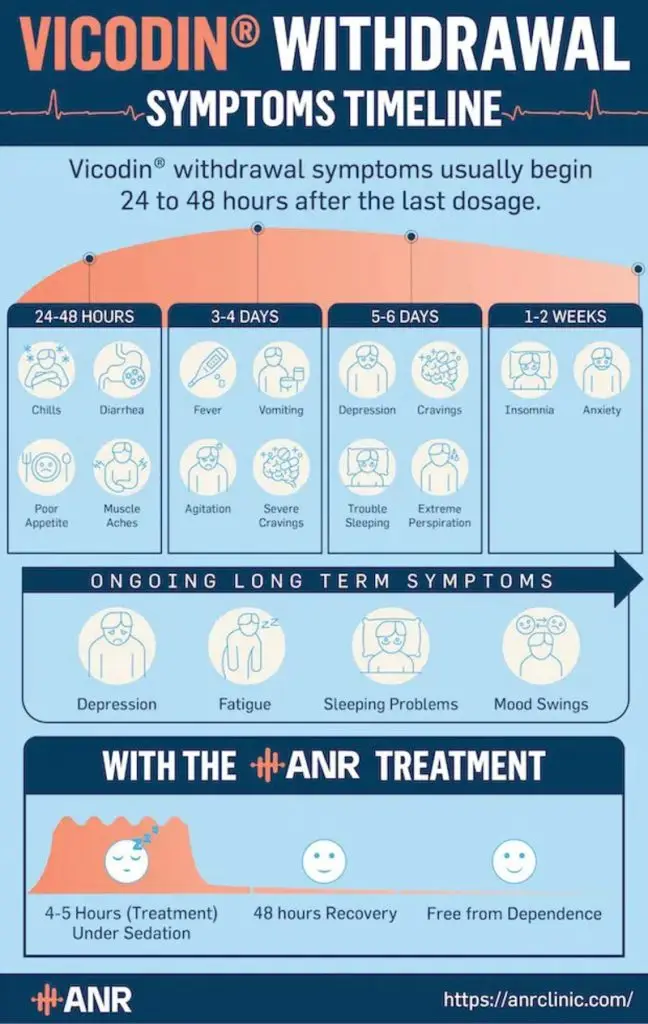
Vicodin withdrawal symptoms occur when people stop taking Vicodin or reduce their dose after becoming dependent or addicted. These symptoms typically occur within 24 hours after last use and persist for around a week. However, their onset, duration, and severity may also depend on individual factors, such as the extent of Vicodin use.
Some of the most common Vicodin withdrawal symptoms include:
- Chills
- Anxiety
- Nausea
- Vomiting
- Diarrhea
- Headache
- Depression
- Watery eyes
- Vicodin cravings
- Stomach cramps
- Sleep disturbances
- Increased sweating
- Muscle and joint pain
- Flu-like symptoms, such as runny nose and fever
Quitting Vicodin abruptly may exacerbate the severity of withdrawal symptoms and is not recommended under any circumstances. Moreover, discontinuing opioids without medical supervision can be extremely dangerous, as it increases the risk of adverse events (e.g., dehydration resulting from nausea), relapse, overdose, and death.
If you’re looking to quit Vicodin, seek professional opioid addiction treatment to get off the medication safely and increase your chances of making a long-lasting recovery.
Preventing Vicodin Overdose
Opting for a non-opioid treatment is the only foolproof way to prevent a Vicodin overdose. After all, even one extra dose taken by accident can lead to a potentially fatal overdose.
If you have no other choice but to undergo opioid therapy, here’s what you can do to decrease the risk of experiencing a Vicodin overdose:
- Take Vicodin strictly as prescribed.
- Carefully track your Vicodin intake.
- Do not increase your Vicodin dose without consulting your doctor.
- Never share Vicodin with others or take medication prescribed for someone else.
- Never mix your medication with any other substances without your doctor’s approval.
- Inform your doctor about any drugs and supplements you’re taking to ensure these won’t interact with Vicodin.
- If you believe you might’ve become dependent on Vicodin, seek professional treatment for opioid dependence.
ANR Treatment for Vicodin Dependence
Accelerated Neuro-Regulation (ANR) is a leading-edge treatment for Vicodin dependence developed by Dr. Andre Waismann. As of today, ANR has helped nearly 25,000 people globally reclaim their lives from opioid dependence.

ANR stands out from other opioid treatment programs in that it acknowledges and addresses the neurobiological causes of opioid dependence, bringing the brain to its pre-addiction state. This is achieved through the process of endorphin-receptor modulation. The procedure is performed under anesthesia, meaning patients experience no discomfort.
Furthermore, ANR treatment boasts an exceptionally high success rate. Since it repairs the opioid-induced neurochemical changes, it eradicates cravings and other withdrawal symptoms, negating the risk of relapse.
Most importantly, ANR is tailored to each patient individually and carried out in an ICU setting of accredited hospitals by highly experienced anesthesiologists, critical care physicians, and other board-certified medical professionals. Therefore, it is very safe—even for those with additional health conditions, such as heart or liver disease.
With an average hospital stay of just 36 hours, ANR can help you break free from Vicodin dependence in just a few days.
Ready to take the first step toward an opioid-free life? Contact us today for a free, 100% confidential consultation!
Key Takeaways
Lastly, let’s summarize the most important points we covered today:
- Vicodin (acetaminophen/hydrocodone) is a combination drug used to relieve moderate-to-severe pain that has a high potential for abuse, dependence, and addiction.
- You can overdose on Vicodin, which is why it is vitally important to take it exactly as prescribed.
- If you notice any Vicodin overdose symptoms, such as unresponsiveness, lip and fingernail discoloration, small pupils, and trouble breathing, call 911 immediately.
- Opioid abuse, low tolerance, and polysubstance use significantly increase the risk of Vicodin overdose.
- ANR is an innovative opioid dependence treatment that can help you make a lasting recovery from Vicodin dependence by re-regulating your endorphin-receptor system.